A Royal Union That Shaped Modern Britain
The marriage of Queen Victoria and Prince Albert on 10 February 1840 was more than a grand royal ceremony — it became one of the most influential partnerships in European history. Their relationship transformed the British monarchy, influenced politics, encouraged scientific progress, and shaped what we now call the Victorian age.
Early Connection and Proposal
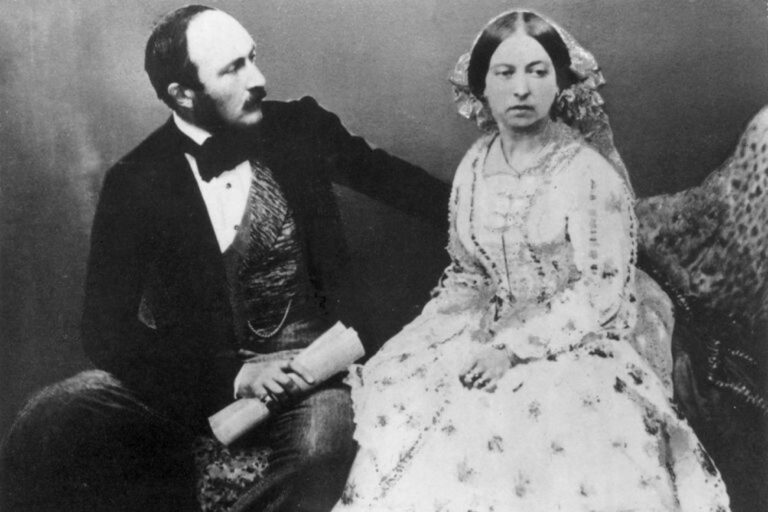
Victoria and Albert were first cousins. Their families arranged meetings during their teenage years, hoping they would eventually marry. When Victoria became Queen of the United Kingdom in 1837 at just 18 years old, the idea of marrying Albert became more serious.
However, royal protocol created a unique situation. Because Victoria was the reigning monarch, she had to be the one to propose. On 15 October 1839, she formally asked Albert to marry her. She later wrote in her diary about how happy and excited she felt after he accepted. This moment showed that their relationship was based on genuine affection rather than pure political calculation.
The Royal Wedding
The wedding took place at the Chapel Royal, St James’s Palace in London. It was a public celebration filled with excitement across the country. Victoria chose to wear a white gown – a bold fashion choice at the time. White wedding dresses were not traditional for royal brides, but her decision started a trend that continues to this day.
The public admired the couple. Newspapers described Albert as handsome and intelligent, and Victoria appeared deeply in love. Their marriage helped create a new image of the monarchy – not distant and purely political, but human and relatable.
A Powerful Political and Intellectual Partnership
Although Albert did not initially receive an official political role, he became Victoria’s most trusted advisor. Over time, he earned the title of Prince Consort. Albert was highly educated and deeply interested in science, technology, art, and social reform.
He encouraged improvements in education, supported the abolition of slavery throughout the British Empire, and promoted technological advancement. One of his greatest achievements was organizing the Great Exhibition in 1851. Held at the Crystal Palace in London, this global exhibition showcased industrial inventions, art, and scientific achievements. It symbolized Britain’s position as a leading industrial power.
Albert’s influence helped modernize the monarchy. He believed the royal family should represent moral values, family stability, and responsibility. This idea shaped public expectations of the monarchy for generations.
Family and European Influence
Victoria and Albert had nine children between 1840 and 1857. Through strategic marriages, their children connected Britain to many royal families across Europe. Because of these family ties, Victoria later became known as the “Grandmother of Europe.”
These family alliances played important roles in European politics. Ironically, several of their grandchildren later found themselves on opposite sides during the First World War. This shows how deeply their family connections influenced continental affairs.
At home, Victoria and Albert promoted a strong image of domestic family life. Paintings and photographs often showed them surrounded by their children, presenting the royal family as loving parents. This public image strengthened support for the monarchy among ordinary citizens.
Albert’s Death and Victoria’s Mourning
In 1861, Prince Albert died at the age of 42, likely from typhoid fever. His death devastated Victoria. She withdrew from public life for several years and wore black clothing for the rest of her life as a symbol of mourning.
Many people criticized her long absence from public duties, but her grief also showed the depth of her love. Albert’s death deeply affected her personally and politically. Despite her sorrow, she continued to rule for nearly 40 more years.
Long-Term Impact on the Victorian Era
The period of Victoria’s reign (1837-1901) is known as the Victorian Era – a time of massive industrial growth, expansion of the British Empire, urbanization, and social reform. Albert’s early influence helped shape many of these developments.
Their partnership strengthened Britain’s global identity and reshaped the monarchy into a more moral and family-centered institution. The traditions, ceremonies, and public image created during their time still influence the British royal family today.
Conclusion
The marriage of Queen Victoria and Prince Albert was not just a royal love story – it was a transformative political and cultural partnership. Together, they shaped the direction of the United Kingdom during one of its most powerful and influential periods.
Their relationship proved that a royal marriage could be built on love, respect, and shared purpose. Even today, their legacy continues to influence how people view monarchy, leadership, and family life in modern Britain.