NEAR Shoemaker’s Historic Asteroid Landing
Space exploration reached a historic milestone on 12 February 2001, when humanity successfully achieved something once thought nearly impossible – landing a spacecraft on an asteroid. This ground-breaking achievement was accomplished by NEAR Shoemaker, a mission led by NASA.
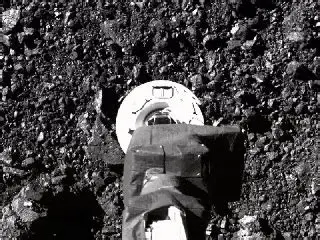
The spacecraft landed on 433 Eros, a near-Earth asteroid located millions of kilometers away, marking the first time a human-made object touched the surface of such a small celestial body.
Background of the NEAR Shoemaker Mission
NEAR Shoemaker, short for Near Earth Asteroid Rendezvous, was launched in 1996 with the primary goal of studying a near-Earth asteroid from orbit. The mission was named in honour of planetary scientist Eugene Shoemaker, a pioneer in asteroid research.
After years of travel and careful navigation, the spacecraft entered orbit around asteroid Eros in February 2000. Over the next year, it sent back thousands of high-resolution images and detailed measurements, helping scientists study the asteroid’s shape, gravity, composition, and surface features.
The Bold Decision to Land
Importantly, NEAR Shoemaker was not designed to land. Its mission plan involved only orbital observation. However, as the spacecraft remained fully functional near the end of its mission, engineers made a bold and risky decision: to attempt a controlled descent onto the asteroid’s surface.
Landing on an asteroid is extremely challenging due to its very weak gravity, irregular shape, and uneven terrain. Even a small miscalculation could have caused the spacecraft to drift away or crash uncontrollably.
Despite these risks, on 12 February 2001, NEAR Shoemaker slowly descended and successfully touched down on the surface of Eros.
Scientific Importance of the Landing
The landing provided scientists with invaluable data that could not be obtained from orbit alone. Even after touchdown, the spacecraft continued transmitting information back to Earth for several days.
The mission helped scientists:
- Understand the surface composition of asteroids
- Measure gravitational forces on small celestial bodies
- Learn how asteroids are formed and evolve over time
This knowledge is crucial for assessing potential asteroid threats to Earth and planning future missions involving asteroid deflection or resource exploration.
Lasting Impact on Space Exploration
NEAR Shoemaker’s success proved that spacecraft can safely approach, orbit, and land on small bodies in space. This achievement paved the way for later missions focused on asteroids and comets, and it played an important role in advancing planetary defence strategies.
The mission changed how scientists view asteroids – not just as distant space rocks, but as accessible worlds that can be explored up close.
What Scientists Said About the NEAR Shoemaker Mission
The successful landing of NEAR Shoemaker on an asteroid drew strong reactions from scientists and engineers involved in the mission, who described it as an unexpected but historic scientific achievement.
Andrew Cheng
Mission Scientist, Johns Hopkins Applied Physics Laboratory
Andrew Cheng stated that the asteroid landing was an unexpected bonus at the end of the mission. According to him, the success proved that controlled operations on very small celestial bodies are possible, something that was uncertain before this mission.
Key idea: The landing expanded the scientific value of the mission beyond its original goals.
Robert Farquhar
Mission Director
Robert Farquhar described the landing as a major engineering success. He emphasized that landing on an asteroid was extremely difficult due to its weak gravity and irregular shape, making the achievement even more remarkable.
Key idea: The mission demonstrated advanced navigation and spacecraft control technology.
Daniel Goldin
NASA Administrator at the time
Daniel Goldin praised the mission as an example of how innovative thinking and efficient planning could deliver world-class science at a relatively low cost. He referred to NEAR Shoemaker as a model for future space missions.
Key idea: Smart mission design can achieve extraordinary results without massive budgets.
NASA Scientists’ Overall View
Scientists at NASA agreed that the mission provided unprecedented data about asteroid composition, gravity, and structure. They noted that this information is vital for:
- Understanding asteroid formation
- Assessing potential threats to Earth
- Planning future asteroid exploration and planetary defence missions.