Introduction
Imagine a future where traffic jams no longer waste hours of your day, emergency medical supplies reach remote locations within minutes, and air taxis become as common as ride-sharing services. What once seemed like science fiction is now moving closer to reality through Advanced Air Mobility (AAM).
Advanced Air Mobility refers to the next generation of aviation technology that uses electric aircraft, drones, and innovative flying vehicles to transport people and goods more efficiently. Around the world, governments, technology companies, and aviation experts are investing heavily in this emerging sector. As cities become more crowded and transportation challenges continue to grow, Advanced Air Mobility is being viewed as a promising solution for the future.
What Is Advanced Air Mobility?
Advanced Air Mobility is a modern transportation system that combines aviation, automation, and electric vehicle technology. It focuses on creating safe, efficient, and environmentally friendly ways to move passengers and cargo through the air.
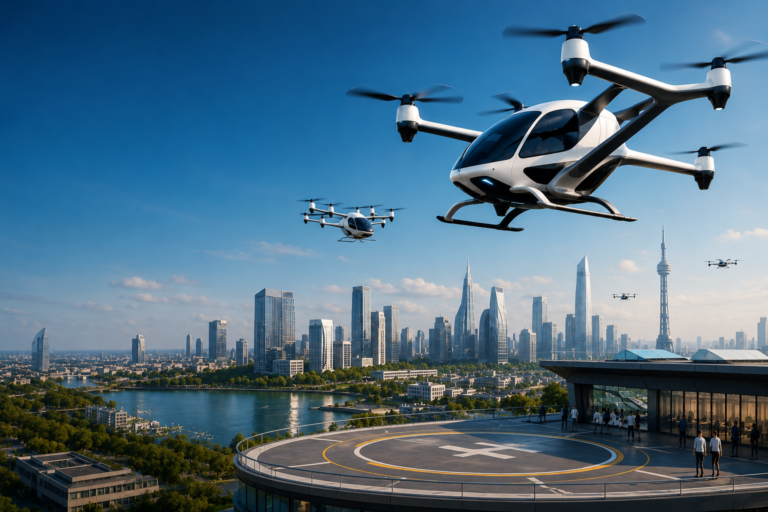
One of the most exciting developments in this field is the rise of electric Vertical Take-Off and Landing (eVTOL) aircraft. These vehicles can take off and land vertically like helicopters while operating more quietly and efficiently. Many companies are developing air taxis that could eventually transport passengers across cities in a fraction of the time required by traditional road transportation.
In addition to passenger travel, Advanced Air Mobility also includes cargo drones, medical delivery aircraft, and emergency response vehicles designed to improve mobility and accessibility.
Why Is the World Investing in Air Mobility?
Urban populations are increasing rapidly, placing enormous pressure on roads, public transportation systems, and infrastructure. Traffic congestion costs billions of dollars every year in lost productivity and fuel consumption.
Advanced Air Mobility offers a potential solution by utilizing the airspace above cities. Instead of adding more roads and highways, transportation networks can expand vertically.
There are several reasons why governments and businesses are investing in this technology:
- Reducing urban traffic congestion.
- Lowering travel times.
- Supporting sustainable transportation goals.
- Improving access to remote and underserved regions.
- Enhancing emergency medical and disaster response services.
Countries such as the United States, China, Japan, South Korea, and several European nations are actively testing new air mobility systems. Many experts believe that commercial air taxi services could become available in selected cities within the coming years.
The Technology Behind Advanced Air Mobility
The success of Advanced Air Mobility depends on several breakthrough technologies working together.
Electric propulsion systems are at the center of most modern air mobility projects. Unlike traditional aircraft engines, electric motors produce fewer emissions and generate less noise. This makes them more suitable for urban environments.
Artificial Intelligence also plays an important role. AI systems can assist with navigation, route optimization, collision avoidance, and aircraft management. Advanced sensors and communication networks help aircraft operate safely in busy airspace.
Another important innovation is autonomous flight technology. While many early air taxis will still have human pilots, future generations may operate with increasing levels of automation. This could reduce operating costs and improve transportation efficiency.
Modern battery technology is also improving rapidly. Longer battery life and faster charging capabilities are making electric flight more practical than ever before.
Challenges That Still Need to Be Solved
Although the future looks promising, Advanced Air Mobility still faces several challenges.
Safety remains the highest priority. Regulatory agencies must ensure that new aircraft meet strict safety standards before carrying passengers. Extensive testing is required to build public confidence.
Infrastructure is another major concern. Cities will need specialized facilities known as vertiports where air taxis can take off, land, recharge, and receive maintenance.
Battery limitations continue to affect aircraft range and payload capacity. While technology is improving, current battery systems still have constraints compared to traditional aviation fuel.
Public acceptance is equally important. People must feel comfortable and safe using air taxis and autonomous flying vehicles. Building trust will require successful demonstrations and consistent safety performance.
In addition, governments must develop new regulations to manage increased air traffic and ensure efficient coordination between aircraft operators.
How Advanced Air Mobility Could Change Everyday Life
The impact of Advanced Air Mobility could be significant across multiple industries.
Commuters may one day travel between cities in minutes instead of hours. Emergency medical teams could transport patients and life-saving supplies much faster. Businesses could benefit from rapid delivery services that reduce shipping times.
Remote communities may gain better access to healthcare, education, and essential services through drone-based transportation networks. During natural disasters, air mobility vehicles could deliver aid to areas that are difficult to reach by road.
For many people, the idea of booking an air taxi through a smartphone application may become as normal as ordering a ride today.
Future Outlook
Advanced Air Mobility represents one of the most exciting transformations in the transportation industry. By combining electric aviation, artificial intelligence, automation, and innovative aircraft designs, AAM has the potential to reshape how people and goods move around the world.
While challenges related to safety, infrastructure, and regulation still exist, progress continues at an impressive pace. The dream of flying taxis and efficient aerial transportation is no longer a distant fantasy. It is becoming a realistic vision of the future.
As technology advances and governments continue to support innovation, Advanced Air Mobility could soon become a part of everyday life, opening a new chapter in the history of transportation.