Celebrating Linguistic Diversity and Cultural Identity
Language is more than just words – it is the soul of a culture, the carrier of history, emotions, traditions, and identity. Every language reflects a unique way of seeing and understanding the world.
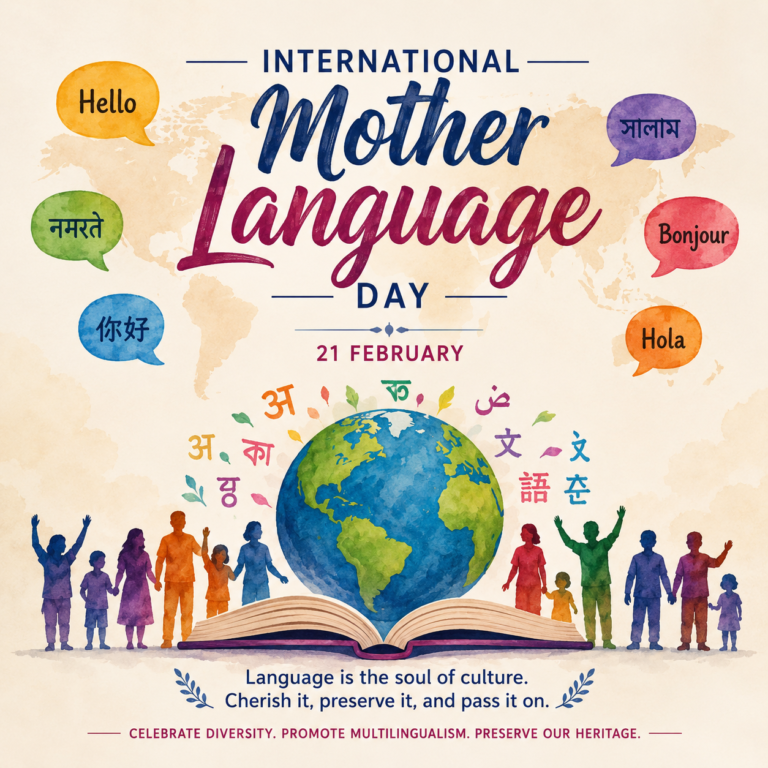
International Mother Language Day, observed every year on 21 February, celebrates the importance of mother tongues and promotes linguistic and cultural diversity worldwide. It reminds us that preserving native languages is essential for protecting human heritage, supporting child development, and building a more inclusive and peaceful world.
Historical Roots: A Day Born from Sacrifice
The day commemorates the Language Movement of 1952 in Dhaka (now Bangladesh). On 21 February 1952, students bravely protested for the recognition of Bangla as an official language. Many sacrificed their lives in this struggle.
Their courage highlighted a universal truth: language rights are human rights. In 1999, UNESCO declared 21 February as International Mother Language Day, later endorsed by the United Nations. Today, this day honors those martyrs and calls upon the world to protect linguistic diversity.
Why Mother Languages Matter
A mother language is the first language a child learns at home. It shapes thoughts, emotions, and worldview. Speaking in one’s native tongue brings comfort, pride, and a deep sense of belonging.
When a language disappears, we don’t just lose words – we lose:
- Unique stories, songs, and oral traditions
- Traditional knowledge of ecology, medicine, and history
- A distinct way of thinking and understanding life
Experts warn that nearly 43% of the world’s 6,000+ languages are endangered. Globalization and dominance of a few major languages threaten thousands of indigenous and regional languages. Protecting them is crucial for preserving humanity’s rich cultural tapestry.
Language, Identity, and Child Development
Mother language is deeply tied to personal and cultural identity. It connects people to their roots, family, and community. Children who learn in their mother tongue develop stronger confidence, better cognitive skills, and a clearer understanding of concepts.
Research shows that:
- Teaching in the mother tongue in early years improves academic performance
- It builds a solid foundation that makes learning additional languages (like English or Hindi) easier later
- It validates a child’s cultural background and boosts self-esteem
Forcing children to study only in an unfamiliar language creates unnecessary barriers and can hinder their overall growth.
The Power of Multilingual Education
International Mother Language Day strongly promotes multilingual education. This approach encourages children to master their mother tongue while also learning national and international languages.
Benefits include:
- Better overall learning outcomes
- Enhanced creativity and problem-solving abilities
- Stronger connection to both local heritage and global opportunities
Multilingualism does not weaken the mother language – it builds upon it, creating confident, adaptable individuals ready for the modern world.
Protecting Endangered Languages in the Digital Age
Technology is now a powerful ally in language preservation. Digital tools, apps, online dictionaries, audio recordings, and social media help document and revive endangered languages.
However, technology alone is not enough. Real change comes from:
- Families speaking native languages at home
- Schools offering mother-tongue education
- Communities recording elders’ stories and creating content
- Governments supporting policies for linguistic inclusion
Linguistic Diversity: A Bridge to Global Peace
Celebrating mother languages is not about division – it is about mutual respect and empathy. When we value other people’s languages, we acknowledge that their culture and identity are as important as our own.
A linguistically diverse world is richer, more creative, and more peaceful. It reduces ethno-centric biases and promotes tolerance, understanding, and unity.
Call to Action: What Can We Do?
- Speak your mother language with pride
- Teach children their native tongue and culture
- Support multilingual education initiatives
- Use technology to document and share local languages
- Respect and appreciate all languages and accents
Governments, schools, organizations, and individuals must work together to create inclusive policies and opportunities.
Conclusion
International Mother Language Day reminds us that every language has value. It is a celebration of identity, culture, heritage, and human connection.
By protecting our mother languages, we preserve the wisdom of generations and ensure a more inclusive future. Let us commit – not just on 21 February, but every day – to speak, teach, and celebrate our linguistic diversity.
Our languages are our identity. Let us keep them alive.